
| FortiGate E-Series vs F-Series vs G-Series: Which Firewall Generation Should You Buy? |
Why Fortinet Has Multiple Firewall Generations on Sale at Once
Fortinet doesn’t retire a hardware generation the moment a new one launches — the E-Series, F-Series and G-Series are all currently sold side by side, at different price points, because they target different priorities: cost, raw performance, and newer feature sets like Wi-Fi 6E readiness and built-in Zero Trust enforcement.
FortiGate E-Series: The Established Baseline
The E-Series (models like the 60E, 100E, 200E and up to the 600E) has been Fortinet’s mainstream line for years. It covers the full range from small-office desktop appliances to mid-range enterprise units, and remains a solid, cost-effective choice where you don’t need the very latest inspection throughput.
FortiGate F-Series: Faster Inspection, Same Form Factor
The F-Series (40F, 60F, 80F, 100F, 200F and beyond) generally sits alongside its E-Series equivalent at a similar size class but with newer network processors (NP7) and content processors (CP9), which translates into meaningfully faster SSL inspection and IPS throughput. If your business has moved most traffic to HTTPS — which is now the norm — the F-Series inspects that traffic faster than the equivalent E-Series box.
FortiGate G-Series: The Current Generation
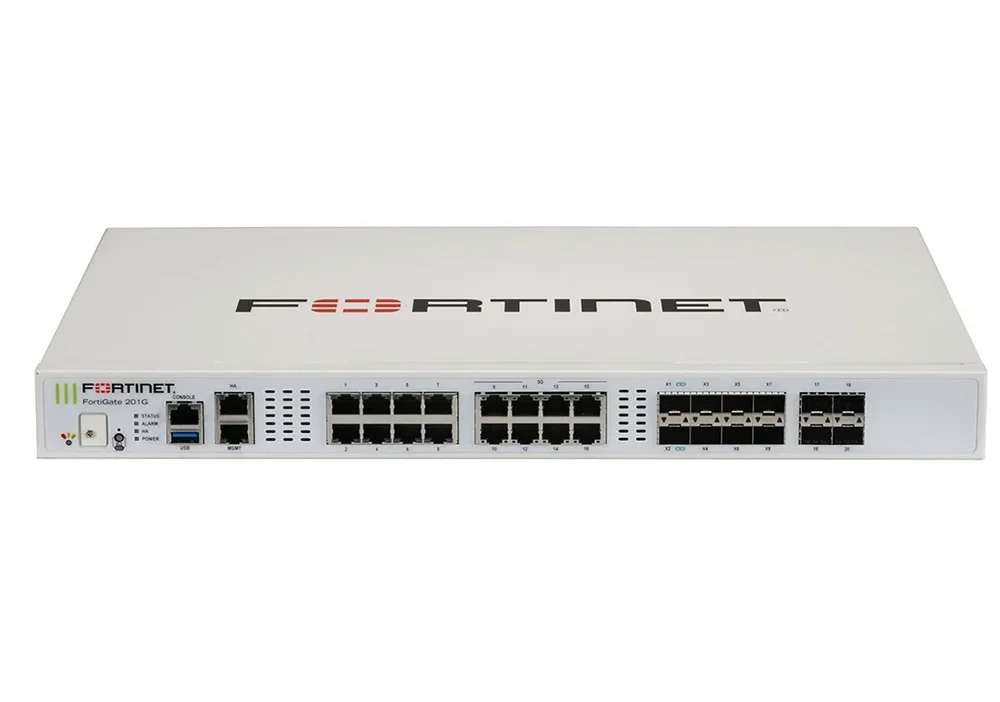
The G-Series (50G, 90G, 120G, 200G and up) is Fortinet’s newest platform, built on further-updated ASIC architecture. Beyond raw speed, the G-Series bakes in newer capabilities like Zero Trust Network Access (ZTNA) enforcement and Wi-Fi 6E readiness for the FortiAP access points that pair with it, generally at lower power draw than the equivalent E/F-Series unit.
How to Actually Decide
- Budget-constrained, traffic is mostly steady-state: E-Series remains a reasonable choice.
- Heavy HTTPS/SSL inspection load, want better performance without jumping size classes: F-Series is usually the better value.
- Standardising for the next several years, want ZTNA and Wi-Fi 6E-ready infrastructure: G-Series is the forward-looking pick.
- Replacing end-of-sale or end-of-support hardware: worth checking Fortinet’s current support lifecycle for your existing model before deciding which generation to move to.
A Note on Comparing Models Directly
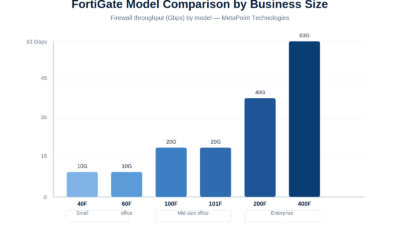
Because model numbers don’t map 1:1 across generations (a ‘100F’ isn’t simply a faster ‘100E’ in every spec), the safest way to compare is by your actual requirement — concurrent users, expected throughput with SSL inspection turned on, and port count — rather than by number alone.
Frequently Asked Questions
Is the G-Series always the right choice since it’s newest?
Not necessarily. If your traffic volume and budget are modest, an E-Series or F-Series appliance may deliver everything you need at a lower cost. Newest isn’t automatically the best fit.
Can I mix generations across my branch offices?
Yes. Since all generations run FortiOS and integrate into the same Security Fabric, mixed environments are common and manage centrally through FortiManager without issue.
Does upgrading generations mean re-licensing everything?
Moving to a new appliance generally requires new hardware and a fresh licence bound to that unit’s serial number; your subscription entitlements can typically be transferred with vendor support.
How do I compare specific models for my environment?
MetaPoint Technologies’s pre-sales team compares models against your actual user count and traffic profile rather than model number alone. Reach out on WhatsApp at +91 99895 44438.
Get Help Choosing the Right Generation
MetaPoint Technologies is an authorised Fortinet partner across Hyderabad, Telangana, Andhra Pradesh and Karnataka, supplying and sizing FortiGate hardware across the E, F and G-Series ranges. Call or WhatsApp +91 99895 44438 for a recommendation tailored to your business.”