

FortiGate Secure SD-WAN lets multi-branch businesses replace or supplement expensive MPLS links with broadband/4G/5G connections while maintaining enterprise-grade security and application performance — typically cutting WAN costs by 30-50% while improving reliability through automatic failover.
The Problem: MPLS Is Expensive and Inflexible for Growing Branch Networks
Businesses operating multiple branches across Hyderabad, Vijayawada, Visakhapatnam, and Bengaluru have traditionally relied on MPLS circuits to connect branch offices to headquarters. MPLS is reliable but comes with real drawbacks for growing businesses:
- High recurring cost per branch, especially for last-mile connectivity in Tier 2 cities
- Long provisioning timelines (4-8 weeks) when opening new branches
- No dynamic path selection — if the MPLS link degrades, there’s no automatic failover to broadband
- Poor visibility into application performance at the branch level
What FortiGate Secure SD-WAN Actually Does
Unlike standalone SD-WAN products that require a separate security stack, FortiGate combines SD-WAN and next-gen firewall security in a single appliance at each branch. This means:
- Multiple WAN links (MPLS, broadband, 4G/5G) are combined and monitored in real time
- Application-aware routing automatically steers latency-sensitive traffic (VoIP, video calls, ERP) over the best-performing link
- Automatic failover happens in milliseconds if a link degrades or drops — no manual intervention
- Full security stack runs at the branch — IPS, antivirus, web filtering, and SSL inspection — instead of backhauling all traffic to a central data center
Typical Architecture for a South India Multi-Branch Deployment
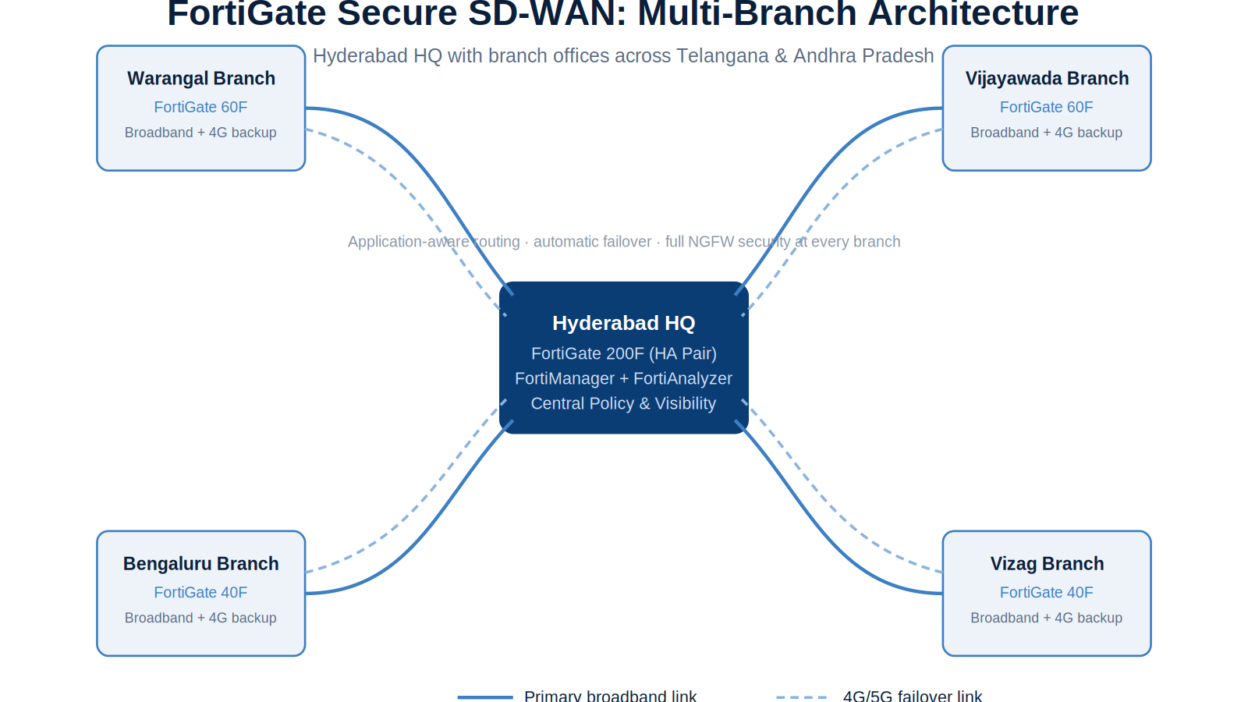
Show Image Hyderabad HQ connected to branch offices via dual-link SD-WAN with automatic failover
For a business with a Hyderabad HQ and branches across Telangana and Andhra Pradesh, a typical FortiGate SD-WAN rollout looks like:
- HQ: FortiGate 100F/200F (HA pair) as the SD-WAN hub
- Branches: FortiGate 40F/60F at each location with dual WAN (broadband primary + 4G/5G backup)
- Management: Centralized policy push and monitoring via FortiManager
- Visibility: FortiAnalyzer for consolidated logging and reporting across all sites
This architecture lets your IT team in Hyderabad push a single policy change and have it apply across every branch within minutes — instead of visiting each site individually.
Real Business Benefits
Cost reduction. Replacing or supplementing MPLS with broadband + FortiGate SD-WAN typically reduces WAN spend significantly, since broadband circuits cost a fraction of equivalent MPLS bandwidth.
Faster branch rollouts. New branch offices can be connected in days using local broadband rather than waiting weeks for MPLS provisioning — a real advantage for retail chains and NBFCs expanding across Telangana and Andhra Pradesh.
Better application performance. Cloud applications (Microsoft 365, Salesforce, Tally on Cloud) perform better when branch traffic goes direct-to-internet rather than backhauling through a central MPLS hub, while still being fully inspected and secured locally.
Simplified compliance. Centralized policy management through FortiManager means every branch enforces the same security posture — critical for BFSI, healthcare, and NBFC clients under regulatory scrutiny.
Common Use Cases We See in Telangana and Andhra Pradesh
- Retail chains with 10-50 outlets needing consistent POS security and centralized Wi-Fi management
- NBFCs and financial services firms with branch networks requiring segmented, auditable connectivity
- Manufacturing groups connecting plant locations to a central ERP with real-time inventory sync
- Healthcare networks connecting clinics/diagnostic centers to a central hospital system with HIPAA-equivalent data handling
Migration Path: Moving from MPLS-Only to SD-WAN
Most businesses don’t rip out MPLS overnight. A typical phased approach:
- Assessment — map current branch connectivity, bandwidth usage, and application criticality
- Pilot — deploy FortiGate SD-WAN at 2-3 branches alongside existing MPLS, running broadband as active-active or active-backup
- Validation — monitor performance and failover behavior for 2-4 weeks
- Phased rollout — extend to remaining branches, downgrading or eliminating MPLS as confidence builds
- Centralize management — consolidate all sites under FortiManager for unified policy and visibility
How MetaPoint Supports SD-WAN Rollouts
We handle end-to-end FortiGate SD-WAN deployments for businesses across Telangana, Andhra Pradesh, and Karnataka — from initial branch network assessment through phased migration and ongoing NOC support. Our scope typically includes:
- WAN link assessment and ISP diversity planning per branch
- FortiGate sizing per site based on user count and application needs
- SD-WAN policy design (application steering, SLA-based routing)
- FortiManager/FortiAnalyzer centralized setup
- Phased cutover with zero/minimal downtime
- Post-deployment monitoring and AMC support
Frequently Asked Questions
Can FortiGate SD-WAN completely replace MPLS? For many businesses, yes — especially where application performance requirements aren’t extremely latency-sensitive. Some regulated industries retain a minimal MPLS backup link for compliance reasons even after SD-WAN adoption.
How many branches make sense for an SD-WAN deployment? Even 3-5 branches see meaningful benefit. The cost and management advantages scale further as branch count grows.
Does SD-WAN compromise security compared to MPLS? No — because FortiGate runs full NGFW security (IPS, AV, web filtering) at each branch, security posture is typically stronger than MPLS-only setups, which often lack local threat inspection.
What’s the typical rollout timeline for 10 branches? Usually 4-8 weeks for a phased rollout, depending on ISP provisioning timelines at each branch location.
Planning a multi-branch network refresh? Contact MetaPoint Technologies for a free branch connectivity assessment.