
FortiGate generally offers the best price-to-performance ratio and the strongest built-in SD-WAN for mid-market Indian enterprises. Palo Alto leads on advanced threat prevention depth and is preferred by large enterprises and BFSI institutions with bigger security budgets. Cisco Firepower fits organizations already standardized on Cisco networking who want unified management. Below is the detailed breakdown.
Why This Comparison Matters for Indian Businesses
Enterprises across Hyderabad, Bengaluru, and the broader South India IT corridor are increasingly moving from legacy UTM appliances to true Next-Generation Firewalls (NGFW). The three vendors that come up in almost every evaluation are Fortinet (FortiGate), Palo Alto Networks, and Cisco (Firepower). Each has real strengths — the right choice depends on your budget, existing infrastructure, and security maturity.
Head-to-Head Comparison
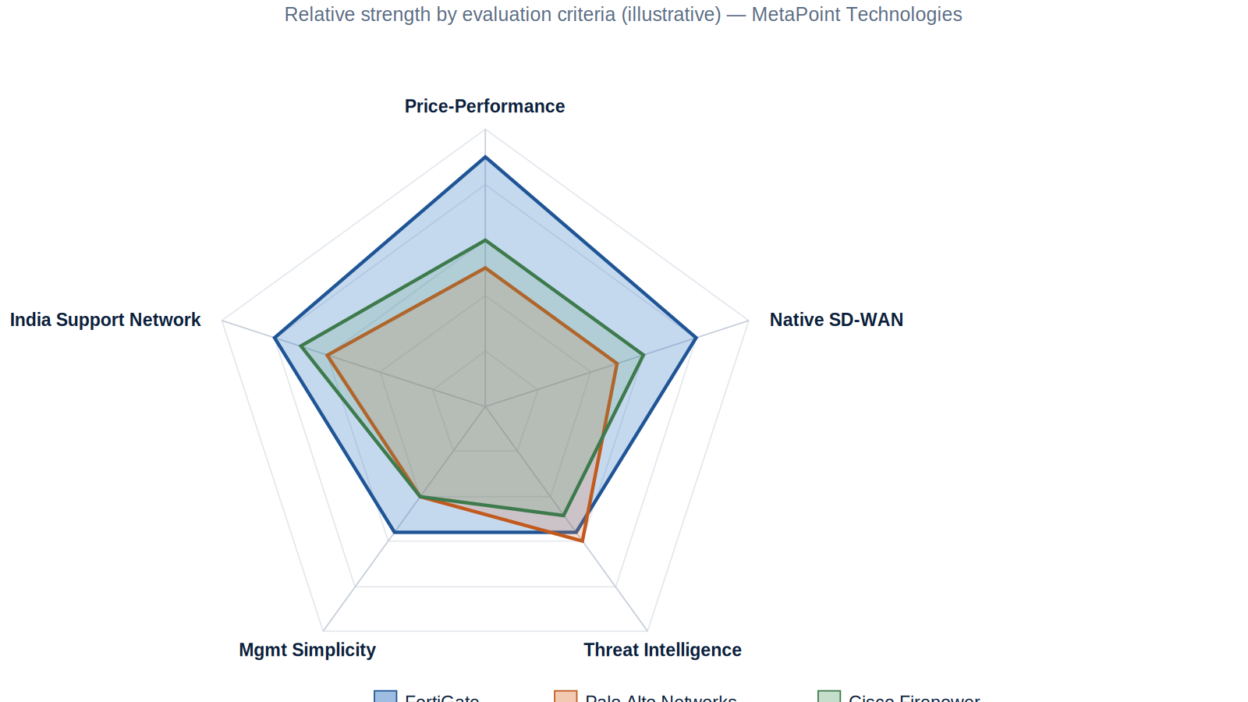
Show Image Relative strength across key evaluation criteria
| Criteria | FortiGate | Palo Alto Networks | Cisco Firepower |
|---|---|---|---|
| Price-performance | Strong — best value at mid-market throughput tiers | Premium pricing, strong ROI at scale | Mid-to-high, often bundled with Cisco ecosystem |
| Built-in SD-WAN | Native, no separate license needed on most models | Requires Prisma SD-WAN (separate product/license) | Requires Cisco SD-WAN (Viptela) — separate stack |
| Threat intelligence | FortiGuard Labs — strong, integrated | WildFire — widely regarded as best-in-class | Cisco Talos — strong, broad visibility |
| Management complexity | Moderate — FortiManager is straightforward | Higher learning curve, Panorama is powerful but complex | Moderate-high, especially in mixed environments |
| Best fit | Mid-market, multi-branch, SD-WAN-first deployments | Large enterprise, BFSI, high-compliance environments | Cisco-standardized networks, unified fabric needs |
| Local Indian support ecosystem | Extensive partner network across Tier 1 and Tier 2 cities | Concentrated among larger system integrators | Broad, tied to existing Cisco relationships |
Where FortiGate Wins
1. SD-WAN is native, not an add-on. For businesses with branch offices across Telangana, Andhra Pradesh, and Karnataka, this is often the deciding factor. FortiGate combines firewall, SD-WAN, and security in a single appliance and license — competitors typically require separate SD-WAN products and licensing stacks.
2. Lower total cost of ownership at mid-market scale. For businesses in the 50-500 user range, FortiGate consistently delivers comparable security depth to Palo Alto at meaningfully lower licensing cost — a significant factor for Indian mid-market IT budgets.
3. Faster deployment timelines. FortiGate’s unified OS (FortiOS) across the entire product line means configuration knowledge transfers directly as you scale from a 60F to a 200F, reducing retraining and deployment time.
Where Palo Alto Wins
Palo Alto’s WildFire sandboxing and App-ID technology are widely regarded as category leaders for detecting zero-day and evasive threats. Large enterprises, BFSI institutions, and organizations with regulatory mandates requiring the most advanced threat prevention often justify the premium cost. If your security team is large enough to fully utilize Panorama’s granular policy capabilities, Palo Alto’s depth pays off.
Where Cisco Firepower Wins
If your organization already runs Cisco switching, routing, and identity infrastructure (ISE, DNA Center), Firepower’s integration into that fabric reduces operational overhead. Unified visibility across the Cisco stack is a genuine advantage for IT teams already invested in that ecosystem.
Total Cost of Ownership: What Actually Drives the Number
Hardware price is only one input. The real TCO comparison includes:
- Licensing bundles (UTM vs Enterprise vs Advanced Threat Protection tiers)
- SD-WAN licensing (included vs separate product)
- Management platform cost (FortiManager vs Panorama vs FMC)
- Support/AMC costs over a 3-5 year hardware refresh cycle
- Training and operational overhead for your IT team
We typically build this out as a full TCO model during a competitive evaluation — reach out if you’d like one for your environment.
Our Recommendation Framework
- Choose FortiGate if: you need SD-WAN + security in one platform, operate multiple branches, or are optimizing for cost-effective enterprise-grade protection.
- Choose Palo Alto if: you’re a large enterprise or regulated BFSI entity where advanced threat prevention justifies premium licensing.
- Choose Cisco Firepower if: you’re deeply standardized on Cisco networking and want single-vendor operational simplicity.
Frequently Asked Questions
Is FortiGate as secure as Palo Alto? For the vast majority of mid-market threat profiles, yes. Palo Alto’s edge is in advanced evasive-threat detection depth, which matters most for high-value, high-compliance targets.
Does FortiGate support Zero Trust Network Access (ZTNA)? Yes — FortiGate includes native ZTNA capabilities as part of FortiOS, without requiring a separate product purchase in most cases.
Which is easier to manage for a small IT team? FortiGate and FortiManager generally have a gentler learning curve than Panorama, making it a practical choice for IT teams without dedicated security specialists.
Can MetaPoint run a side-by-side POC? Yes. We regularly run competitive POCs — including FortiGate vs Palo Alto Prisma Access evaluations — for clients across South India before finalizing a procurement decision.
Evaluating firewall vendors for your organization? Talk to MetaPoint about a structured, vendor-neutral POC.